
Java 26 Is Here: What Business Owners Need to Know About the Future of Enterprise Software
Java 26 launched on March 17, 2026 with game-changing performance, AI-readiness, and security upgrades. Here's what it means for your business—and why hiring a Java developer who knows Spring AI could be your best investment this year.
What Is Java 26—and Why Should Your Business Care?
Java 26 became generally available on March 17, 2026, continuing the language's reliable six-month release cadence. It is a short-term release packed with 10 officially approved JDK Enhancement Proposals (JEPs) that directly impact performance, security, AI readiness, and developer productivity.
If you run a business that relies on software—whether it's a web platform, internal tool, mobile backend, or enterprise system—the technology stack your developer chooses matters enormously. Java remains the backbone of some of the world's largest companies (Netflix, LinkedIn, Amazon, Uber), and Java 26 is the clearest signal yet that the language is doubling down on AI and modern cloud infrastructure.
This post breaks it all down: what changed, why it matters compared to older Java versions, how Spring AI fits into the picture, and what you should look for in a Java developer in 2026.
Java 26 vs. Previous Versions: The Evolution at a Glance
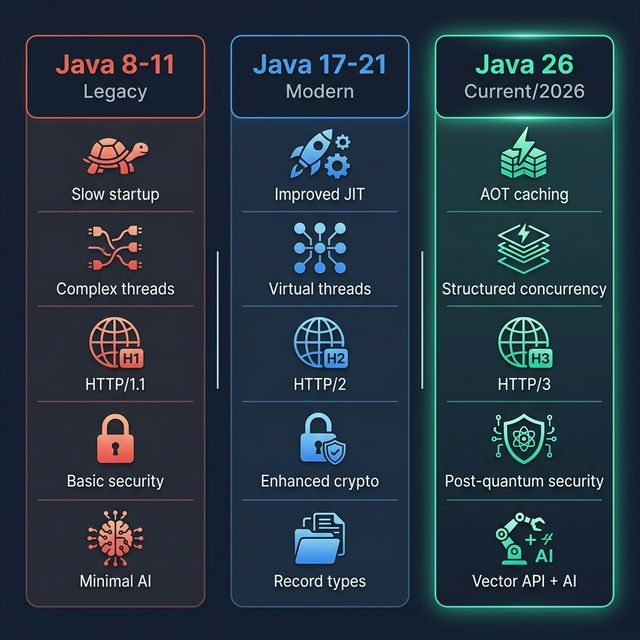
The jump from Java 8 or 11 (still running in many legacy systems) to Java 26 is not just a version number—it's a full platform modernization. Businesses still on old Java versions are carrying technical debt that slows down feature delivery, increases security risk, and makes hiring harder.
The 10 JEPs in Java 26: What They Mean in Plain English
1. JEP 516: Faster App Startup—No More Waiting
What it is: Ahead-of-Time (AOT) Object Caching now works with any garbage collector, including ZGC.
What it means for your business: Your applications launch faster. This is critical for cloud-native deployments and serverless functions where cold-start time directly impacts user experience and billing costs. In previous versions, AOT caching was limited and didn't play well with modern GC (garbage collection) strategies. Java 26 removes that constraint.
Business impact: Faster app startup = better user experience, lower cloud costs, faster scaling.
2. JEP 517: HTTP/3 Native Support
What it is: The Java HTTP Client API now natively supports HTTP/3, the latest internet protocol built on QUIC.
What it means for your business: HTTP/3 dramatically reduces latency, especially on mobile networks and across long distances. Any API your app calls—payment processors, AI services, third-party integrations—can now benefit from faster and more reliable connections without any extra infrastructure work.
Business impact: Faster APIs, better mobile experience, reduced timeout errors.
3. JEP 522: Better Performance Under Load
What it is: Improvements to the G1 Garbage Collector reduce synchronization between application threads and GC threads, increasing throughput.
What it means for your business: Your high-traffic backend handles more requests per second without added hardware. If you're running e-commerce, SaaS, or any system with spikes in traffic, this is free performance.
Business impact: More users served with the same infrastructure cost.
4. JEP 500: Safer Code—"Final Means Final"
What it is: Java 26 introduces warnings when code tries to modify final fields using deep reflection—a technique that, while powerful, is also a security and stability risk.
What it means for your business: This is a safety guardrail that prevents developers (or malicious libraries) from mutating data that should be immutable. It's a step toward more predictable, safer applications.
Business impact: Reduced risk of subtle bugs and security vulnerabilities.
5. JEP 504: Applet API Removed
What it is: The ancient Applet API is permanently removed. It was deprecated back in Java 17 and no browser has supported it in years.
What it means for your business: If your company has old intranet tools built with Java Applets, this is the migration deadline signal. Any developer worth hiring in 2026 can help you modernize those tools to a modern web stack.
Business impact: A push to finally retire legacy systems that were already security liabilities.
6. JEP 530: Primitive Pattern Matching—AI Inferencing Gets Easier (Fourth Preview)
What it is: Java's pattern matching system now supports all primitive types in patterns, instanceof, and switch statements.
What it means for your business: This unlocks more expressive, cleaner code—and more importantly, it makes Java far better at AI inferencing workloads. When running machine learning models or processing large data pipelines, working with primitive types (ints, floats, bytes) is essential. Java 26 makes this natural.
Business impact: A Java developer can wire AI models into your application more cleanly and efficiently.
7. JEP 525: Structured Concurrency (Sixth Preview)
What it is: A high-level API that treats groups of concurrent tasks as a single, manageable unit—with unified error handling, cancellation, and observability.
What it means for your business: Modern applications do many things in parallel: call APIs, query databases, process events. Structured Concurrency makes this dramatically simpler to code correctly, reducing the risk of bugs like memory leaks, stuck threads, and silent failures.
// Java 26: Concurrent API calls with structured error handling
try (var scope = new StructuredTaskScope.ShutdownOnFailure()) {
    Future<CustomerData> customer = scope.fork(() -> fetchCustomer(id));
    Future<OrderHistory> orders  = scope.fork(() -> fetchOrders(id));
    Future<AIRecommendations> recs = scope.fork(() -> getAIRecommendations(id));

    scope.join().throwIfFailed();

    return new DashboardResponse(customer.get(), orders.get(), recs.get());
}
Business impact: More reliable concurrent apps with fewer production incidents.
8. JEP 524: PEM Encoding API—Security for the Modern Stack (Second Preview)
What it is: A new standard API for handling PEM-encoded cryptographic objects: keys, certificates, and CRLs.
What it means for your business: Security compliance, TLS certificate management, and cryptographic operations are now easier to implement correctly. Java developers no longer need to rely on brittle third-party libraries for this critical functionality.
Business impact: Easier compliance (SOC 2, HIPAA, PCI DSS) and lower risk of cryptographic mistakes.
9. JEP 529: Vector API—Hardware-Accelerated AI (Eleventh Incubator)
What it is: The Vector API allows Java code to execute SIMD (Single Instruction, Multiple Data) vector computations that compile directly to optimized CPU instructions.
What it means for your business: This is the foundation of high-performance AI and data processing in Java. Tasks like vector similarity search (used in RAG systems and semantic search), signal processing, and numerical computing run dramatically faster—without leaving the JVM.
// Vector API: parallel processing for AI feature extraction
static final VectorSpecies<Float> SPECIES = FloatVector.SPECIES_256;

float[] dotProduct(float[] a, float[] b) {
    var sum = FloatVector.zero(SPECIES);
    for (int i = 0; i < a.length; i += SPECIES.length()) {
        var va = FloatVector.fromArray(SPECIES, a, i);
        var vb = FloatVector.fromArray(SPECIES, b, i);
        sum = va.fma(vb, sum);
    }
    return sum.reduceLanes(VectorOperators.ADD);
}
Business impact: Faster AI-powered features without needing a separate Python microservice.
10. JEP 526: Lazy Constants (Second Preview)
What it is: An API for values that are initialized once on first use and then treated as true JVM constants—allowing the JIT compiler to optimize aggressively.
What it means for your business: Configuration values, API keys, connection strings, and feature flags loaded at startup can be treated as constants after initialization. This eliminates a class of runtime performance overhead in long-running services.
Business impact: Faster, memory-efficient enterprise applications.
Spring AI + Java 26: The Most Powerful AI Stack for Enterprise
If you're looking to add AI capabilities to your Java application in 2026, Spring AI is the framework your developer should be reaching for—and Java 26 makes it dramatically better.
What Is Spring AI?
Spring AI is the official AI integration layer for the Spring ecosystem (the most widely used Java framework in enterprise development). It lets Java teams add AI features to their existing Spring Boot applications without rewriting anything and without learning a completely new technology stack.
Think of it like this: if your business already runs on Spring Boot (which millions of companies do), Spring AI is the plug-in that gives you:
- Chat interfaces backed by OpenAI, Anthropic, Google Gemini, AWS Bedrock, and more
- Retrieval-Augmented Generation (RAG) pipelines that answer questions using your data
- Structured outputs that turn AI responses into typed Java objects
- Tool/function calling so AI models can trigger real business actions
- Built-in observability: token usage, latency, error rates, and cost monitoring
How Java 26 Supercharges Spring AI
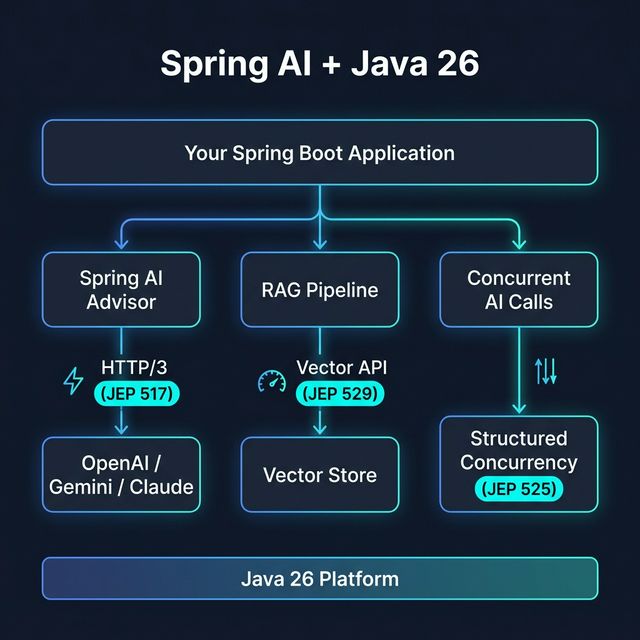
Real example—building a smart customer support bot with Spring AI on Java 26:
@Service
public class CustomerSupportService {

    private final ChatClient chatClient;
    private final VectorStore vectorStore;

    // Spring AI: RAG-powered support with your business knowledge base
    public String handleQuery(String customerId, String question) {
        // Retrieve relevant docs from your knowledge base
        List<Document> context = vectorStore.similaritySearch(
            SearchRequest.query(question).withTopK(5)
        );

        // Call AI with context + customer data (HTTP/3 under the hood)
        return chatClient.prompt()
            .system("You are a support agent for Acme Corp. Answer only using the provided context.")
            .user(question)
            .advisors(new QuestionAnswerAdvisor(vectorStore))
            .call()
            .content();
    }
}
This is production-ready AI—not a toy demo—and it runs on your existing Java infrastructure.
What This Means If You're Hiring a Java Developer
If you're a business owner evaluating developers or agencies, here's your 2026 Java hiring checklist:
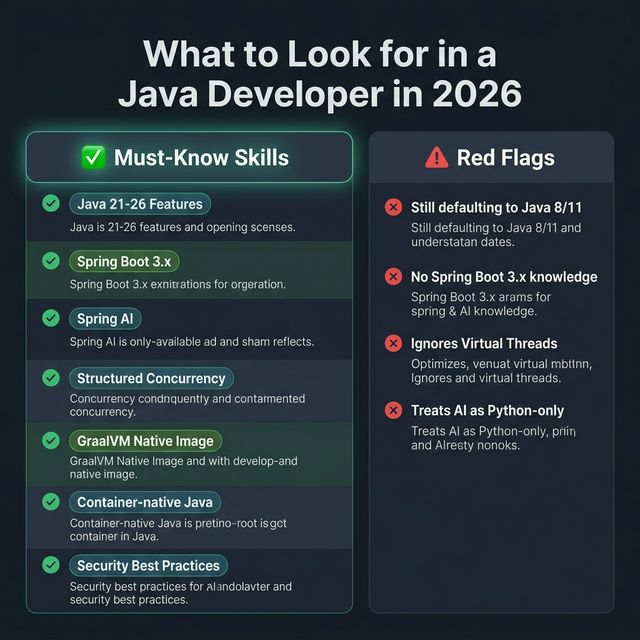
Java 26 Security: Why Your CTO (or Future CTO) Will Care
Java 26 ships with post-quantum-ready cryptography:
- Hybrid Public Key Encryption (HPKE) support
- Post-quantum JAR signing—resistant to quantum computer attacks
- PEM Encoding API for cleaner, safer cryptographic key management
Post-quantum cryptography matters for businesses that handle sensitive data—financial, healthcare, legal, or SaaS with long contract lifetimes. The data encrypted today may be decrypted by quantum computers in 5–10 years. Java 26 developers can now implement quantum-resistant security measures without external libraries.
The Business Case in Numbers
Organizations that upgrade their Java stack and adopt modern APIs consistently report:
- Meaningful reductions in cloud infrastructure costs from improved GC throughput and faster startup
- Significantly faster feature delivery cycles from structured concurrency and modern APIs eliminating thread-management overhead
- Fewer production incidents from improved concurrency models (no more thread leaks, race conditions, or silent failures)
- AI features deployed in weeks, not months, using Spring AI on existing infrastructure
Staying on Java 8 or 11 means:
- Paying more for the same compute power
- Slower onboarding for new developers (Java 26 devs don't want to work on legacy stacks)
- Mounting security technical debt
- Missing out on AI without a full rewrite
Frequently Asked Questions
Is Java 26 production-ready?
Yes. Java 26 GA (General Availability) was released on March 17, 2026. Preview features like Structured Concurrency and Primitive Pattern Matching are stable enough for non-critical paths and are finalized in subsequent versions.
Should I upgrade from Java 21 (LTS) to Java 26?
Java 21 remains the Long-Term Support (LTS) version with full commercial support. Java 26 is a short-term release, ideal for greenfield projects, innovation, and staying current. Talk to your developer about a gradual migration path.
Do I need to rewrite my Spring Boot app to use Spring AI?
No. Spring AI is additive. You add it as a dependency to your existing Spring Boot 3.x project and start building AI features incrementally.
What does "post-quantum" security mean for my business?
It means your cryptographic protections are designed to resist attacks from quantum computers—which are expected to break many current encryption methods within the next decade. Java 26 gives your developer the tools to implement this today.
Closing: Why Java in 2026 Is the Best Bet for Serious Businesses
Java is no longer the "old enterprise language." Java 26 is a modern, AI-ready, cloud-native platform that powers systems at global scale. With Spring AI, HTTP/3, Structured Concurrency, Vector API, and post-quantum security all landing this year, the developer who knows Java 26 deeply is one of the most valuable engineers you can hire.
If you're building or scaling a software product and want a developer who understands all of this—not just the syntax, but how it translates to business outcomes—I'd love to talk.
Schedule a Technical Consultation →
Published March 20, 2026. Java 26 GA released March 17, 2026. All JEP references are from the official OpenJDK project.
Want to discuss this further or work together?